


The Writing World Blinked, And Everything Changed
Not long ago, the biggest technological debate in writing circles was whether to outline in Scrivener or just use a legal pad and a prayer.
Those were simpler times.
In the last two to three years, artificial intelligence has walked into the writing world, helped itself to a seat at the table, and apparently has no intention of leaving. Whether I think that's exciting, terrifying, or somewhere in the vicinity of "I need to lie down for a minute," the conversation is happening whether I join it or not.
And it is moving fast. Blink-and-you'll-miss-it fast.
Where We Were
Not long ago, AI writing tools were clunky, obvious, and about as useful as a grammar checker that flagged every sentence over twelve words. Writers tried them, shrugged, and went back to their legal pads.
The results read like a robot had skimmed a few novels and decided it understood human emotion. It did not.
Where We Are Now
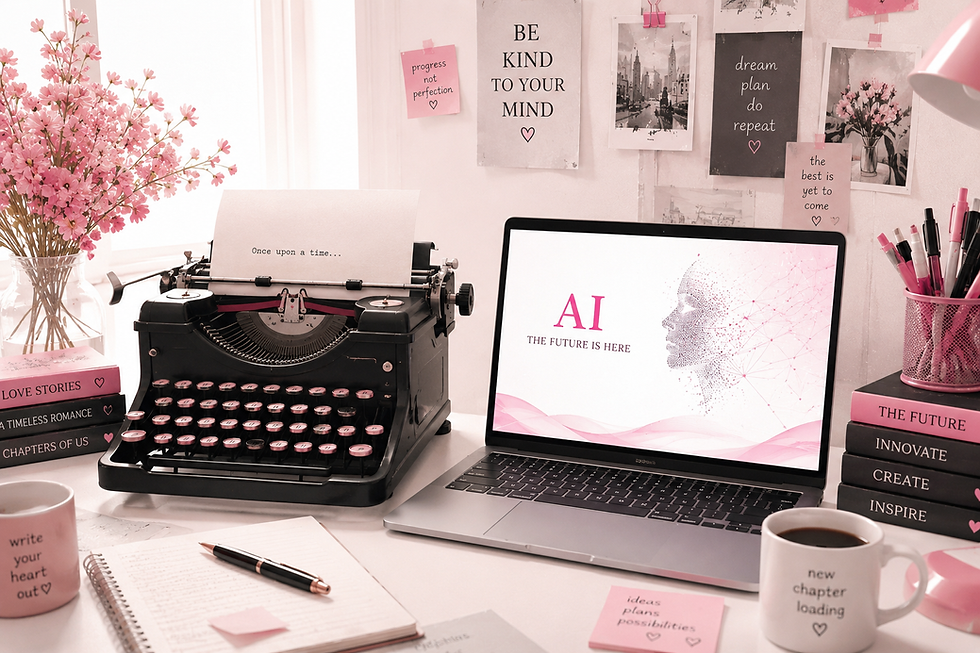
The tools available today are a different animal entirely. Writers are using AI for brainstorming, research, plotting, editing feedback, marketing copy, and about seventeen other things that would have sounded like science fiction five years ago.
The output isn't perfect. Anyone who tells you otherwise is selling something. But the gap between "obviously generated" and "genuinely useful" has closed faster than most of us expected.
What This Means for Me as a Writer
Here is the honest truth, served without a side of panic: every generation of writers has had to adapt to something.
The typewriter replaced the pen. The word processor replaced the typewriter. The internet changed publishing, self-publishing changed the industry, and e-readers changed how readers consume books. Each shift came with loud voices on both sides predicting either utopia or the death of literature as we know it.
Literature survived. Writers adapted. Readers kept reading.

And it isn't just writing. When cameras were invented, painters were furious. Photography was going to kill art. It didn't. It just changed what art looked like and who was making it. Then film photographers had the same reaction when digital cameras arrived. All that craft, all that darkroom expertise, suddenly obsolete? The outrage was real. And yet photography didn't die. It evolved. Some photographers embraced digital. Some didn't. The good ones kept making images worth looking at either way.
AI feels like one of those moments. The landscape is shifting, the voices are loud on every side, and nobody really knows yet exactly where it all lands.
The One Thing I Keep Coming Back To
What I do know is this: no tool, no algorithm, and no technological leap has figured out how to replace the story only I can tell. My characters, my world, the specific way I see something and put it on a page. That didn't come from a program. It came from a life. From faith. From sixty-plus years of watching people and quietly taking notes.
Readers don't fall in love with software. They fall in love with characters and worlds and the particular turn of phrase that makes them stop and read a sentence twice. Whatever tools the writing world adopts, and it will keep adopting new ones, that part stays human. That part stays mine.
The writing world blinked. It's going to keep blinking. I plan to be at my desk when the dust settles, whatever that desk looks like, squinting at the screen and refusing to quit anyway.


Comments